

As a supplier of floor protector film, I often get asked a crucial question from customers: "Can floor protector film be used on uneven floors?" This question is not only common but also significant, as many floors in both residential and commercial settings are far from perfectly flat. In this blog, I'll explore this topic in depth, providing insights based on our experience in the industry.
Understanding Uneven Floors
Before delving into the use of floor protector film on uneven floors, it's essential to understand what uneven floors are. Uneven floors can result from various factors. In older buildings, natural settling over time can cause the foundation to shift, leading to dips, bumps, and slopes in the floor surface. Water damage is another culprit; when water seeps into the sub - floor or underlayment, it can cause warping and buckling, creating an uneven terrain. Poor installation of flooring materials can also lead to an uneven finish. For example, if the sub - floor was not properly leveled before laying tiles or hardwood, the final floor will be uneven.
Challenges of Using Floor Protector Film on Uneven Floors
Using floor protector film on uneven floors presents several challenges. One of the most obvious issues is adhesion. Floor protector films typically rely on adhesives to stick to the floor surface. On an uneven floor, the adhesive may not make full contact with the entire surface. There could be air pockets between the film and the floor, especially in the dips. These air pockets not only reduce the overall adhesion strength but also create a less - than - smooth appearance. Over time, the film may start to peel at the edges or in areas with air pockets, leaving parts of the floor unprotected.
Another challenge is durability. Uneven floors have areas of high and low stress. The bumps on the floor can put extra pressure on the film, causing it to wear out faster in those areas. The film may also tear more easily if it is stretched over a large bump or dip. In addition, dirt and debris can accumulate in the uneven areas, and when the film is applied, it can trap these particles between the film and the floor. This can cause scratches on the floor surface when the film is removed, defeating the purpose of using the protective film in the first place.
Types of Floor Protector Films and Their Suitability
There are different types of floor protector films available in the market, and each has its own level of suitability for uneven floors.
Temporary Floor Protection Film
Click here to learn more about Temporary Floor Protection Film. Temporary floor protection films are often used during construction or renovation projects. These films are usually thinner and more flexible compared to permanent ones. They can conform to minor unevenness on the floor to some extent. The flexibility allows them to bend over small bumps and into shallow dips, providing a basic level of protection. However, for significant unevenness, their adhesion and durability may still be compromised.
Household Decoration Floor Plastic Protective Film
Explore our Household Decoration Floor Plastic Protective Film. This type of film is designed for long - term use in homes. It is generally thicker and more robust. While it offers better protection against scratches and stains, it may have more difficulty adhering to uneven floors. The stiffness of the film can make it challenging to fit into the contours of an uneven surface, and any air pockets or improper adhesion can be more noticeable and long - lasting.

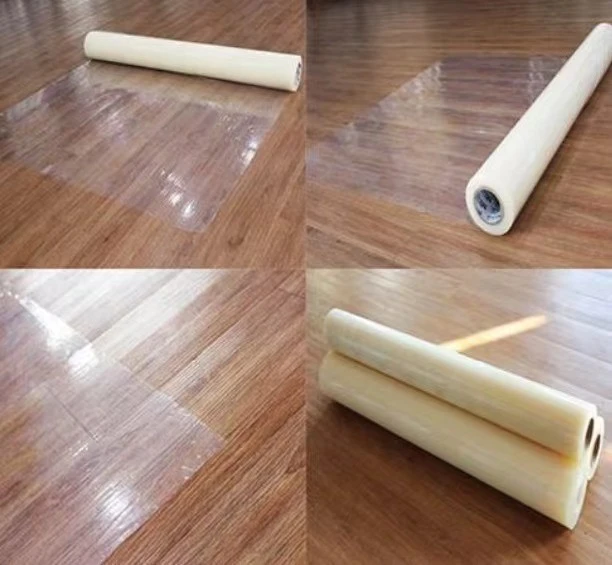
Plastic Film For Protecting The Floor Surface
Check out our Plastic Film For Protecting The Floor Surface. This is a broad category that includes films with different properties. Some plastic films are designed to be more stretchable and conformable, which can be more suitable for uneven floors. They can better adapt to the shape of the floor, reducing the likelihood of air pockets and improving adhesion.
Solutions for Using Floor Protector Film on Uneven Floors
Although there are challenges, there are also solutions for using floor protector film on uneven floors.
Surface Preparation
One of the most effective solutions is to prepare the floor surface before applying the film. This can involve filling in small dips and leveling out minor bumps. For small dips, a self - leveling compound can be used. It is a liquid material that spreads evenly over the floor and hardens to create a flat surface. After the compound has dried, sanding the surface can further smooth it out. This preparation step can significantly improve the adhesion and performance of the floor protector film.
Choosing the Right Film
As mentioned earlier, not all floor protector films are created equal. When dealing with uneven floors, it's crucial to choose a film that is flexible and has good conformability. Some films are specifically designed for uneven surfaces and have features like enhanced stretchability and stronger adhesives that can better grip the floor.
Installation Techniques
Proper installation techniques can also make a difference. When applying the film, start from one end of the floor and gradually unroll it, smoothing out any wrinkles or air pockets as you go. Use a squeegee or a roller to press the film firmly onto the floor, especially in the areas with unevenness. If there are large bumps or dips, you may need to cut the film into smaller pieces and apply them separately to ensure better adhesion.
Case Studies
To illustrate the practical application of floor protector film on uneven floors, let's look at a few case studies.
In a small residential bathroom renovation project, the floor had some minor unevenness due to water damage. The contractor decided to use a temporary floor protection film. Before applying the film, they filled in the small dips with a self - leveling compound and sanded the surface. The flexible temporary film was then carefully installed, and it adhered well to the floor, providing protection during the renovation process.
In a commercial office building, the floors had significant unevenness caused by the building's settling. The facility manager chose a plastic film specifically designed for uneven surfaces. The installation team used a piece - by - piece method to apply the film, which resulted in a smooth and well - adhered finish. The film protected the floors during a major office redecoration project.
Conclusion
In conclusion, while using floor protector film on uneven floors presents challenges, it is definitely possible with the right approach. Surface preparation, choosing the appropriate film, and using proper installation techniques are key to achieving good results. As a supplier of floor protector film, we are committed to providing high - quality products and expert advice to our customers. Whether you are dealing with a minorly uneven residential floor or a highly uneven commercial space, we have solutions to meet your needs.
If you are interested in purchasing floor protector film for your uneven floors or have any questions about our products, we encourage you to reach out to us for a detailed discussion. Our team of experts is ready to assist you in finding the best floor protection solution for your specific situation.
References
- Building Construction Handbook by Arthur B. Gallant
- Flooring Installation Guide published by the National Wood Flooring Association
- Research on Adhesive Performance on Uneven Surfaces from the Journal of Adhesion Science and Technology