


Packaging Stretch Film
Wholesale Packaging Stretch Film Manufacturer
Haining Gaosheng Protective Film Co., Ltd., is a professional enterprise integrating R&D, production and sales of various surface protective films. Our products include Carpet Protection Film, Floor Protection Film, Tile Protection Film, Marble Protection Film, Glass Protection Film, Barrier Film, Stainless Steel Protection Film, Aluminum Protection Film, Anti-Static Film, Metal Protection Film, Household Appliance Protection Film, Car Protective Film, Packaging Stretch Film, Packaging Tape.
Why Choose Us?
Rich Experience
Haining Gaosheng Protective Film Co., Ltd. was established in 2002. After 20 years of intensive cultivation, it has become an enterprise with a certain reputation and customer trust in the industry.
Wide Range of Applications
Our products are widely used in industries such as aluminum-plastic panels, stainless steel panels, color steel panels, galvanized panels, glass, stone, electronics manufacturing, home appliances, automobile manufacturing, and high-end furniture.
Advanced Equipment
We have a full set of advanced film blowing equipment, printing equipment and a number of coating lines and cutting lines.
Professional Technical Team
We have an excellent and professional team with over 30 people working on researching, producing and sale.


Brief Introduction to Packaging Stretch Film
Stretch wrap or stretch film, sometimes known as pallet wrap, is a highly stretchable plastic film that is wrapped around items. The elastic recovery keeps the items tightly bound. In contrast, shrink wrap is applied loosely around an item and shrinks tightly with heat. While it is similar to plastic food wrap, it is not usually made of material rated as safe for food contact.
It is frequently used to secure pallet loads to one another but also may be used for bundling smaller items. Types of stretch film include bundling stretch film, hand stretch film, extended core stretch film, machine stretch film and static dissipative film.
Economical
Stretch film is substantially less expensive to use than strapping materials or heat-shrinkable bags. Hand stretch films are capable of stretching in the 25-35% range. Machine-applied stretch film can be stretched anywhere from 75% to more than 200%. This means your roll price of film goes a long, long way.
Strong
An important feature of stretch film is memory; in other words, it wants to go back to its original length, like a rubber band. This means that once the film is stretched, it continues to exert a great deal of holding force on your load — keeping items securely in place, even during rough shipments. Stretch film can be punctured, but tears will not propagate, again keeping your items secured.
Transparent, Tinted or Opaque
The clarity of stretch film is important in many applications, such as when visible inspections are needed. If, however, you want your product to be unseen — for example, to deter theft or for color-coding in storage — tinted or opaque options are available.
Uv-Inhibiting Films
For outside storage and food products, UV protection is crucial, and stretch films with UV additives are readily available to meet the need.
Eco-Friendly
Stretch films are easily recyclable, and some films are manufactured with a percentage of recycled resins. Further, since stretch film stretches so much, relatively little packaging material is needed.
Safe
Strapping, the main alternative to stretch film, can cause injury when being applied or when being taken off a pallet. Stretch film is much safer to use.
Moisture Resistance
Another advantage of stretch film over strapping is a stretch-wrapped load is resistant to moisture — a key consideration for outside storage, shipment on flatbed trailers, etc.
Types of Packaging Stretch Film


Cast Stretch Film
Cast stretch film is made by applying a comprehensive manufacturing operation called cast extrusion. This action mandates the continual thrusting of a thermoplastic substrate into a flat die and onto a cooled roll.
The film gauge is resolved by how quickly the casting roll drags the plastic away from the die. This treatment causes cast films to boast superior clarity, allowing end users to observe the wrapped objects. This film stretches easier due to the molecules being aligned as they're extruded.
Cast stretch film is exceedingly quiet when removed from the roll and relatively simple to stretch. Cast stretch film also provides two-sided cling that grants wrapped products the ability to remain firmly wrapped during transportation.
While cast stretch film has multiple fantastic attributes, such as a more affordable cost than blown film, it does not hold a candle to blown film in sustaining strength or protection against tearing. Cast stretch film can generally stretch easily but has less robust stretch memory than other films.
Blown Stretch Film
Blown stretch film is created through a function called blown extrusion. This operation involves plastic melt being pushed into a circular slit die, resulting in a refined tube.
Next, the air is pushed into the tube, granting the volume of air enclosed to expand the tube to the optimal width. The tube is topped with an air ring which is then blown onto the substrate to chill. Chilling the material provides the blown film with greater strength and flexibility than other wraps.
As blown film is generally more robust than most other stretch wraps, it also boasts excellent resistance to tearing.
This is advantageous when containing loads with pointy edges vulnerable to collapsing thinner films. Blown films provide a high degree of memory when stretched. This means that packages remain secured.
Unfortunately, blown film is more expensive and has poorer transparency than other films. It also produces what some consider an annoying level of noise when compared to other similar substrates.
Pre-Stretch Film
Pre-stretched film is expanded near its breaking point before it is wrapped onto rolls. This film does not necessitate as much energy as other stretch films to achieve the same wrapping force.
Pre-stretched film consumption often uses around 50% less than other stretch films, making for potentially extreme cost reductions.
Hay Baling Stretch Film
Hay baling stretch film is a multi-layer specialty stretch wrapping substrate made for wrapping baled rolls of hay. It is used primarily in the agricultural and farming industries.
Also known as silage stretch wrap, many types of these wraps feature LDPE (low-density polyethylene) formulations with oxygen barriers to keep your hay bales dry.
Hand Stretch Film
Hand stretch film is made exclusively to be wrapped by human labor manually. It is also known as hand film, hand stretch wrap, hand wrap, or manual pallet wrap.
It is commonly used by companies that wrap small volumes of products. Generally speaking, that would be companies that wrap less than 50 pallets per day.
The capabilities of manual stretch film must be continually checked against the various potential improvements that come with switching to a stretch wrapping machine.
Selecting the proper stretch application for your packaging line will improve efficiency and result in a more cost-effective production.
Color Stretch Film
Color stretch films were created to serve a very specialized niche area of packaging needs that other stretch film types cannot adequately service.
Color stretch film is perfect for warehouse color coding, international transportation, or dating inventory. Color stretch wrap is designed to be resistant to puncture.
UVI Stretch Film
Ultraviolet film is a stretch film with special light-discouraging additives that defend it from photographic degeneration in applications where wrapped products are kept outside and exposed to the elements.
VCI Stretch Film
VCI, or Vapor Corrosion Inhibitor stretch film, is made specifically for wrapping metal components, so they don't rust. This formulation prevents the oxidation of metals and is commonly used for packaging tools, metal pipes, and other metal products or materials.
Reinforced Stretch Film
Reinforced stretch films are thick films with especially strong formulations used to package and protect hefty loads for transportation and shipping. For example, this type of film is commonly used for palletizing and unitizing bricks and cinder blocks.
Vented Stretch Film
Vented stretch film is commonly utilized in applications where airflow and oxygen need to be available for packaged products. IE: wrapping pallets of wood, hot bakery items, etc.
NO Cling Stretch Film
No cling stretch film is used for packaging products such as carpeting so that the products being packaged can slide on and over each other without getting caught and tearing. There is also a variant of no-cling stretch film that has only one side that clings called one-sided cling stretch film.
Specialty Stretch Films
In some cases, specialized wrapping projects require the implementation of performance films with multiple layers with very high stretch capabilities. In addition, gauge reductions can be used, resulting in uncommon thicknesses of stretch films for similar applications.
Applications of Packaging Stretch Film
Palletized Boxes
This is the most common and widely seen use of stretch film. Boxes of different sizes and weights are stacked on a pallet and wrapped with stretch film to keep them together.
Buckets
Buckets of items such as paint, liquids, and dry goods are commonly wrapped with a heavier gauge stretch film to keep the contents in and from spilling.
Wire Reels
The film can be used to unitize reels together and it can also be used to prevent the wires from unwinding.
Canned Beverages
Another common use is to wrap around beverages. They are often stacked high and they are heavy, using the film keeps them together and from falling over with being stored and delivery purposes.
Furniture
Manufacturers and movers often use stretch film to secure the product, to keep it together, and to keep it from getting damaged while moving.
Feed and Seed
Pallet loads of feed and seed or often very heavy. Depending on the weight of the pallet shrink film can be used to keep it stable.
Process of Packaging Stretch Film
Blown
The resin is melted and extruded through an annular die, it is air-cooled. This is a slower process but provides for higher cling quality. Blown film is not a consistent extrusion process, leading to inconsistencies across the film web. The cost of production is also higher due to the quantity that can be produced per hour.
Cast
The film is extruded through a slot die, then passed over cooling rollers. This makes the cooling process quick. Cast films are more consistent and have better performance characteristics. The cling quality is not as good as blown but more can be produced in an hour with lower costs.
How to Store Stretch Wrap?
Short-Term Storage
Short-term film storage is the practice of storing wrapping film rolls for a short period before their use in the production process. This is a critical step in ensuring that the product remains properly protected during transit and storage, providing an additional level of protection for your valuable goods. Proper short-term film storage helps to keep your wrapping rolls in prime condition for use in the production process, preserving their integrity and minimizing potential waste due to spoilage or damage.
When storing wrapping film rolls, it’s important to ensure that they are stored away from direct sunlight and in a dry environment. Moisture can cause wrappers to degrade over time, leading to deformation and potential wastage. Additionally, the temperature of the storage area should be kept consistent – fluctuating temperatures can lead to premature aging of the roll and affect its performance when used for production. It’s also important to ensure that the storage space is well-ventilated, as this will help to keep the film rolls in good condition.
Long-Term Storage
When it comes to long-term storage, a wrapping film roll must be properly handled and stored. Firstly, the rolls should be inspected for any damage or contamination, which could cause the roll to degrade over time. Secondly, the rolls should be stored in an environment that is dark, dry, and well-ventilated. Exposure to light and moisture can reduce the quality of the film. Thirdly, it is important to ensure that the temperature stays within a range of 55°F and 77°F (13°C to 25°C). Finally, store wrapping film rolls away from chemicals, as this can also affect their performance when in use. With these precautions in mind, you can guarantee that your wrapping film roll will remain intact for long-term storage.
Performance
Selecting a stretch film that provides the right yield strength and performance for the loads being wrapped is crucial. The yield strength denotes the amount of stress a stretch film can withstand without permanently having plastic deformation. Prior to reaching the yield point a stretch film will elastically deform but return to its original shape once the stress is removed.
Overlapping
This is a technique for covering the top of your pallet using polythene top sheets. This protects your products and provides a downward force on the pallet load. When overlapping hand applied films, it is recommended users allow up to a 50% overlap. If using machine applied films, users should allow a 50mm overlap, regardless of the film width.
Banding
This refers to applying multiple wraps of stretch film to a particular area of a pallet to reinforce the load or band multiple units together.
Neckdown
This happens when a film loses its dispensing roll width and narrows down while being stretched. Neckdown reduces the coverage each wrap provides thereby making it likely that more wrap rotations and more film will be needed to wrap a load or pallet.
Time, Use and Cost Use
Hand wrapping is best suited for smaller or sporadic stretch film wrapping requirements. For example, if you are moving home or office, hand wrapping with stretch wrap will be more than adequate.
Alternatively, introducing machine wrapping may ultimately save time, resources, and packaging materials.
Our Certificate
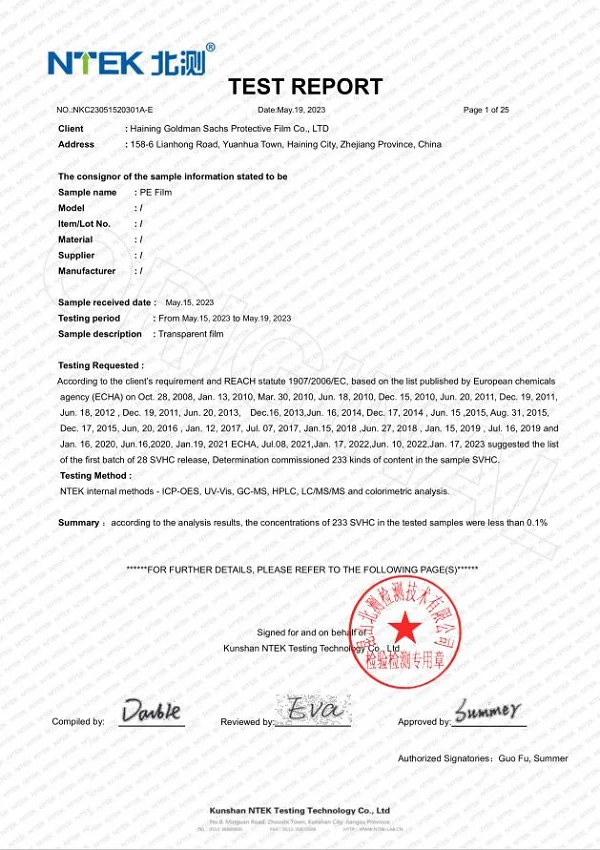
Our company have approved by ISO9001 International Quality System Certification, MSDS Report, ROHS Report and REACH Report, strictly carried it out in the process of research, production and selling.



Our Factory
The company has advanced printing equipment and coating equipment, adopts strict quality inspection system, and has passed ISO9001 management system certification for many years. The company always adheres to the tenet of building the foundation of quality, establishing the monument of quality, and raising the sail of the brand.


Contact Us
Name:
Serena
1
>>
Phone:
+86-18867669661
+86-18324364871
2
>>
Email: 1525262631@qq.com
3
>>
What's up/Wechat:
+86-18324364871
4
>>
Address:
No. 158-6, Lianhong Road, Yuanhua Town, Haining City, Jiaxing City, Zhejiang Province
5
Frequently Asked Questions
Q: What Are the Benefits of Stretch Wrap?
Q: What are the common types of Packaging Stretch Film?
Q: Why do people use Packaging Stretch Film for packaging?
Q: What are the common specifications of Packaging Stretch Film?
Q: What are the common applications of Packaging Stretch Film?
Q: What are the advantages of Packaging Stretch Film?
Q: How To Make Stretch Film?
Q: Shrink Film and Stretch Film: What’s the difference?
Q: How to properly store stretch wrap?
Q: What Element In Stretch Film Makes It The Ideal Material For Wrapping?
Q: Why use stretch films to wrap your goods?
Q: What items can be packaged with Packaging Stretch Film?
We're well-known as one of the leading packaging stretch film manufacturers and suppliers in China. Please feel free to wholesale high quality packaging stretch film made in China here from our factory. For custom service, contact us now.
Stretch Wrap Film, plastic stretch wrap film, Packaging Stretch Film