


Anti-Static Film
Wholesale Anti-Static Film Manufacturer
Haining Gaosheng Protective Film Co., Ltd., is a professional enterprise integrating R&D, production and sales of various surface protective films. Our products include Carpet Protection Film, Floor Protection Film, Tile Protection Film, Marble Protection Film, Glass Protection Film, Barrier Film, Stainless Steel Protection Film, Aluminum Protection Film, Anti-Static Film, Metal Protection Film, Household Appliance Protection Film, Car Protective Film, Packaging Stretch Film, Packaging Tape.
Why Choose Us?
Rich Experience
Haining Gaosheng Protective Film Co., Ltd. was established in 2002. After 20 years of intensive cultivation, it has become an enterprise with a certain reputation and customer trust in the industry.
Wide Range of Applications
Our products are widely used in industries such as aluminum-plastic panels, stainless steel panels, color steel panels, galvanized panels, glass, stone, electronics manufacturing, home appliances, automobile manufacturing, and high-end furniture.
Advanced Equipment
We have a full set of advanced film blowing equipment, printing equipment and a number of coating lines and cutting lines.
Professional Technical Team
We have an excellent and professional team with over 30 people working on researching, producing and sale.


Brief Introduction to Anti-Static Film
An anti static film, also known as an antistatic polyethylene film, is a specialized material designed to minimize or eliminate the buildup and discharge of static electricity. It is commonly used in various industries, particularly in manufacturing, electronics, and packaging, where the control of electrostatic discharge (ESD) is critical.
ESD anti static films are typically made from polyethylene, a versatile and durable polymer. To impart antistatic properties, additives such as carbon or metallic compounds are incorporated into the film during the manufacturing process. These additives facilitate the dissipation of static charges, preventing them from accumulating on the surface of the film or any objects in contact with it.
What are Advantages of Anti-Static Film?
Reduced Damaged Goods
They prevent static electricity from building up and discharging which causes most damages.
Reduced Costs
With your electronics being better protected, there will be less chance of damage and so you will be saving money that would have been spent on repairs.
Increased Efficiency
The lack of damaged goods will result in a higher efficiency as you will have to deal with less returns.
Increased Customer Satisfaction
Save customers being frustrated about damaged products and having to wait for a new item.
What are Features of Anti-Static Film?
Toughness
Tough film suitable for industrial materials thanks to its high tensile strength in both the vertical and horizontal directions due to its biaxial orientation.
Transparency
Film that is difficult to damage and features excellent transparency and gloss.
Moisture Resistance
Not affected by moisture as water vapor permeability is extremely low, making it difficult for the film to absorb moisture.
Easy Release
The untreated surface displays the easy release characteristics of polypropylene.
Electrical Characteristics
High insulation resistance and few insulation defects make it suitable for applications requiring a high level of reliability. Low dissipation factor suitable for high precision circuits and AC use.
Light Permeability
Films have excellent UV transparency and are used in various applications.
Types of Anti-Static Film
Static Dissipative Films
Static Dissipative films are polymers or plastic that deliver a surface resistivity of 106 to 1012 ohm/sq. These films allow for the dissipation or decay of electrical charges at a much faster rate than anti-static materials, generally within milliseconds. The measured resistance is uniform and usually strong. The color variants are available in translucent, black, and other available colors as per consumer requirements.
Antistatic Films
Antistatic films are polymers or plastic that deliver a surface resistiviy of 1010 to 1012 ohm/sq.These films provide a decay of static charge, from hundredths of a second to several seconds, preventing accumulations that could otherwise lead to discharge or the initiation of charges to other nearby electrical events which can result in catastrophic scenarios. The color variants are available in translucent, black, and other available colors as per consumer requirements.
Conductive Films
Conductive films are polymers or plastic that deliver a surface resistivity of 101 to 106 ohm/sq.Decay rates in conductive films are measured in nanoseconds and are instant enough to provide a ground pathway and discharge off even the strongest of the electrical charges.
Applications of Anti-Static Film
Covering Up Atex Surface Area
It is majorly done because ATEX surfaces are referred to as the hazard of explosive atmospheres occurring in the workplace due to the presence of flammable gasses or combustible dust mixed in the air. This indicates a high-risk region prone to explosion.In such a scenario even a little electric spark coming from a frictional surge can result in a huge explosion. In order to avoid such risk, Anti-static film is ideal for covering ATEX surface area since it prevents the building up of any changes in such a hazardous atmosphere.
Electronics Manufacturing and Packaging
Anti-static films' dissipative property is ideal for electronics manufacturing and packaging it is because electronic products themselves contain the volume of electrical sparks that are necessary for their functioning. It is because of this reason a control measure is required in order to displace the charges to the ground. The static dissipative films are ideal for these types of application, as it allows the charges to flow into the ground in a more controlled manner. This in turn helps in protecting electronic goods.
Medical Trays and Packaging
Conductive films are majorly used for these types of applications in order to avoid static shock in operating rooms. It is because medical trays have a strong tendency to accumulate surface electrostatic charges. This charge can stay on the surface of the films until it discharges when the material comes into contact with another surface for discharge. This can lead to issues such as increased handling problems; excessive dust and dirt build up on the surface of the films part, parts sticking, resulting in damages to sensitive medical products. It is because of this reason conductive films that have the ability to displace charges to the ground at a rapid rate, even when in contact with a person, clearly make it easier for people to handle medical trays and products. Further, it also prevents people from having static shock along with the building up of dust in the product. This in turn helps in protecting the medical goods when conductive films are used for their packaging.
Other Generalized Application
Since all the three Anti-Static films reduce the charges from either occurring or properly displacing, the films are ideal for using in Clean Room since it prevents the dust from being attracted to the surface because of lack of electric charges. Further, these films are also ideaI for Document Protection and other transportation and packaging process in the industry because oftheir Anti-static properties, which ensure the better safekeeping of the products from dust, charging damages, and possible explosions.
The Considerations for Buying
Research and Identify Reliable Suppliers
The first step in buying anti-static film internationally is to identify reputable suppliers. Research potential suppliers online, check their credentials, read customer reviews, and assess their experience in the anti-static film industry. Look for manufacturers or distributors that have a proven track record in producing high-quality products.
Quality Standards and Certifications
Ensure that the anti-static film you intend to purchase meets the necessary quality standards and certifications. Quality standards can vary from one country to another, so it’s crucial to understand the specific requirements for your industry. Look for suppliers that can provide documentation certifying their product’s compliance with relevant quality standards.
Product Specifications
Clearly define the specifications of the anti-static film you require. This includes the film’s width, thickness, length per roll, and any specific features such as UV resistance, anti-static properties, or color. Providing detailed specifications to potential suppliers will help you receive accurate price quotes and avoid misunderstandings.
Price and Payment Terms
Request price quotes from multiple suppliers to compare costs. Consider additional expenses such as shipping, customs duties, and taxes. Negotiate payment terms that are mutually beneficial and ensure secure payment methods to protect both parties.
Shipping and Logistics
Coordinate the shipping and logistics of your anti-static film. Decide whether you will handle shipping arrangements yourself or if the supplier can provide shipping services. Consider factors such as shipping lead times, import/export regulations, and the most cost-effective mode of transportation.
Customs and Import Regulations
Familiarize yourself with the customs and import regulations of both your country and the supplier’s country. Ensure that all necessary paperwork, including invoices, import licenses, and customs declarations, is in order to prevent delays and potential issues at customs.
Communication and Language
Clear and effective communication is crucial when dealing with international suppliers. Ensure that you and your supplier can communicate effectively, either in a common language or with the help of translation services. Miscommunication can lead to misunderstandings and delays.
Quality Control and Testing
Consider implementing a quality control process to ensure the anti-static film meets your specifications and quality standards. This may involve on-site inspections, product testing, or third-party quality control services.
Long-Term Relationship
Building a long-term relationship with your international supplier can provide stability and continuity in your supply chain. Regular communication, fair negotiations, and mutual trust can foster a strong and lasting partnership.
Legal Agreements
Always have legal agreements in place to protect your interests. Contracts should outline terms and conditions, responsibilities, warranties, and dispute resolution mechanisms. Consult with legal professionals to ensure your contracts are legally binding and enforceable.
Our Certificate
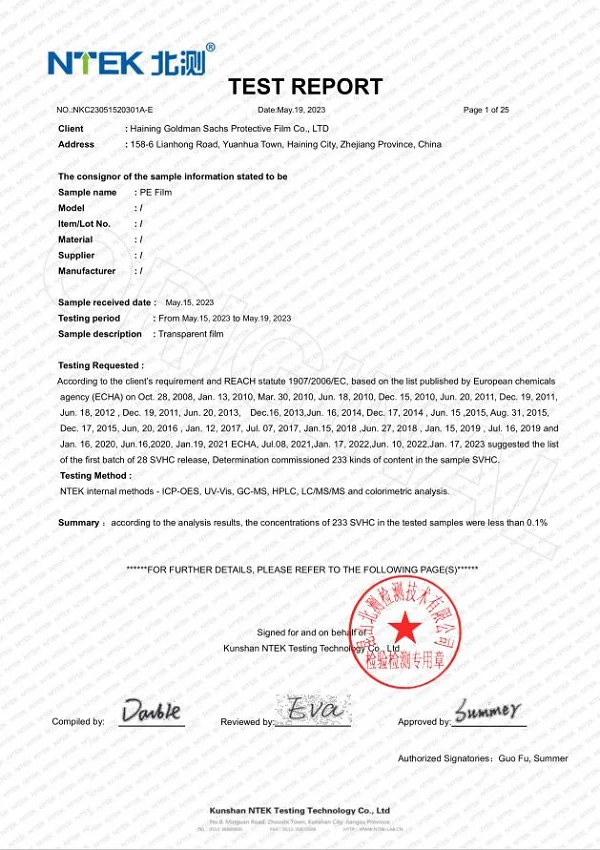
Our company have approved by ISO9001 International Quality System Certification, MSDS Report, ROHS Report and REACH Report, strictly carried it out in the process of research, production and selling.



Our Factory
The company has advanced printing equipment and coating equipment, adopts strict quality inspection system, and has passed ISO9001 management system certification for many years. The company always adheres to the tenet of building the foundation of quality, establishing the monument of quality, and raising the sail of the brand.


Contact Us
Name:
Serena
1
>>
Phone:
+86-18867669661
+86-18324364871
2
>>
Email: 1525262631@qq.com
3
>>
What's up/Wechat:
+86-18324364871
4
>>
Address:
No. 158-6, Lianhong Road, Yuanhua Town, Haining City, Jiaxing City, Zhejiang Province
5
Frequently Asked Questions
Q: How these Anti-Static Films are developed?
Q: What are the benefits of using Anti-Static Film?
Anti-static films are available in a wide range of colors and industries can select the ideal color that suits their product requirement.
Anti-Static films safeguards products from dust accumulation.
Anti-Static films save cost behind cleaning of the product covered in dust.
Ani-Static films are waterproof to a large extent since they are mad of and hence can protect the product from water exposure.
Removing Anti-Static films from product packaging is easier since they do not stick to the product.
Anti-Static films are ideal for long journey transportation where risk factors of charge building are much higher.
Anti-Static films protect the product from scratches to a good extent during the process of loading and unloading.
These are some of the additional benefits that an industry can enjoy with the usage of anti-static films for their packaging purposes.
Q: What other types of Anti-Static Film are there?
Pink Film
Pink film, also commonly known as antistatic lay flat tubing, is a type of ESD packaging material that is used to safely wrap non-electrostatic-sensitive products used in the electronics industry i.e. instruction manuals, nuts and bolts. The film is typically manufactured from a durable polythene and coated with an anti static coating. Its anti static coating allows the film to safely come into close proximity to static-sensitive electronics. One characteristic that distinguishes pink film to other types of film packaging is its red-tinted polythene colour – often described as pink. This colour helps to inform those working in an Electrostatic Protected Area (EPA) that the material can safely be used. It is important to note that pink anti static film does not protect static-sensitive components against electrostatic charge (ESD).
Antistatic film is specially developed to help eliminate static charge build-up, mitigating the risk of ESD damage and creating a static-free work area. Static charge build-up typically occurs when two surfaces make contact with one another and cause friction; this is known as tribocharging. In addition, reducing the risk of static damage to valuable electronic components can help to retain their performance and life-span, saving businesses money annually. Most pink layflat tubing is 75 microns thick which provides good scratch protection for the contents inside. Film pink packaging has a typical surface resistance of less than 10^(10) Ohms per metre.
Products can be placed in the tubing and cut to size. Once the tubing is cut to the required length, it can be sealed. This process enables the best fit whilst helping to reduce wastage.
Conductive Film
Conductive black film has been developed to effectively dissipate static charges while preventing electrical tribocharge. Its tough, puncture-resistant material makes it a suitable choice for the handling, shipping and storage of static sensitive electronics and other items. An easy way to distinguish conductive film from other types of packaging film is its notable appearance; opaque and black in colour.
Conductive black film is a cost-effective packaging solution that is commonly used in the electronics and chemical industries. Many businesses opt for this type of packaging material due to its abundance of benefits. Here are several advantages of conductive film:
Heat-sealable
Flexible
Offers exceptional chemical and abrasion resistance
Provides both physical and static protection
Conductive properties are unaffected by humidity and age
Volume-conductive
Groundable.
Conductive films are particularly used for medical trays and packaging. This is to help avoid static shock in operating rooms.
Static Shielding Film
Static shielding film, also known as ESD protection film, provides the uppermost protection to valuable electronics. This type of film is an effective packaging solution for the handling, storage and transportation of ESD sensitive electronic devices. They are widely used in the electronics industry for storing printed circuit boards (PCBs), IC integrated circuits, hard drives and CDs.
Static shielding film typically has a four-layer structure: static dissipative coating, polyester, aluminium shield and static dissipative polyethylene. The static dissipative layer offers a low charging outer-surface. The polyester layer of the film works with the metal layer to provide a Faraday Cage. In addition, the aluminium layer helps to suppress any electric fields, while the polyethylene layer prevents electrical tribocharge.
As for the properties, most static shielding films have a typical thickness of 75 microns thick to offer good scratch protection for the electronics inside. When looking to purchase static shielding film, you would want to make sure the film has a good thickness of around 75 microns. While thickness is one factor, the transparency of the film is another. Static shielding film is notable for its semi-transparent appearance. The semi-transparency enables for easy identification of the contents inside the ESD protection film.
Static shielding film can often be confused with anti static film or pink film. A helpful tip to differentiate the two is to think of the colour. Static shielding film is semi-transparent (which can appear as grey or silver in colour) and anti static film / pink film is typically pink or red in colour. Despite this, it’s always best recommended to check the product’s specifications so you can be sure of the electrical properties.
Moisture Barrier Film
Moisture barrier film offers exceptional protection for static sensitive and moisture sensitive electronic devices, particularly SMT (Surface Mount Technology) products. This type of packaging film helps to protect electronics from moisture and static damage during storage and transit e.g. integrated circuits or PCBs. The film is typically utilised in industries with humid environments.
Although static shielding film and moisture barrier film are both silver/grey in colour, their transparencies set them apart from each-other. In contrast to static shielding film, moisture barrier film is opaque and light-tight in appearance. This ensures the contents cannot be seen from the outer-layer, providing an extra layer of operational security.
Generally, moisture barrier film is constructed with three layers: static dissipative polyester, aluminium shield and static dissipative polyethylene. The aluminium layer offers discharge shielding, blocks moisture and minimises the penetration of electric fields and electrostatic discharges (ESDs).
Moisture barrier film is typically 100 microns thick (4 mils) to provide good protection and flexibility for the contents inside. There are many benefits for using moisture barrier film, including the following:
Suitable for vacuum-sealing
Puncture-resistant
Moisture-proof
Opaque
Faraday Cage protection
One of the best ways to optimise the performance of your moisture barrier film is using a desiccant bag and a humidity indicator card alongside it.
Q: What are the reasons for using Anti-Static Film?
The electrical charge (static) will exert a force on nearby charged objects or a grounded conductor.
Among the problems caused by this force are:
Dust clinging to product.
Product clinging to itself, rollers, machine beds or frames.
Materials tearing, jamming, or curling.
Film or sheet feeding problems.
Hazardous sparks or shocks, causing damage to electronic components during handling.
Charged conductors, like metals, discharge completely when grounded. Insulators, like plastics, do not conduct electricity and cannot discharge when grounded.
Static charge built-up can attract dust onto a food package, which is undesirable aesthetically.
At times, static charge can damage circuit boards in electronics packaging and may cause hazards of fire or explosion in the vicinity of flammable materials.
The static charge may also cause processing problems such as difficulty in winding of films, or the agglomeration of powders during transport. Such undesirable effects can be avoided by using anti-static film.
Q: Why choose our Anti-Static Film?
Our Anti-Static PE Film is designed to address the challenges posed by static electricity in various industries. Whether you're working with sensitive electronics, medical devices, precision instruments, or delicate materials, our film offers effective static control, preventing damage caused by electrostatic discharge (ESD).
Enhanced Safety and Quality Assurance
Our film provides a low surface resistance, ensuring efficient static dissipation and preventing the accumulation of static charges. This reduces the likelihood of sparks, shocks, or other hazards that can compromise product safety and worker well-being. Additionally, our film is designed to be transparent, allowing for easy visual inspection and quality assurance checks without compromising the protective properties of the film.
Versatility and Ease of Use
Our Anti-Static PE Film offers versatility and ease of use, making it suitable for a wide range of applications. It can be used as a protective layer for electronic components during transportation, storage, or assembly. It is also an ideal choice for packaging materials, preventing static-related issues that can impact the quality and functionality of your products. With its excellent dimensional stability and resistance to moisture and chemicals, our film maintains its protective properties even in challenging environments. It can be easily cut, folded, or heat-sealed to fit your specific requirements, ensuring a seamless integration into your manufacturing or packaging processes. Our Anti-Static PE Film provides the flexibility and convenience you need to protect your sensitive products with ease.
Trust Anti-Static PET Film Solutions
Our Anti-Static PE Film offers advanced technology, superior static dissipation, and enhanced product preservation. With our commitment to quality, safety, and customer satisfaction, we strive to exceed your expectations and provide you with the best solutions for your static control needs.
Q: What is the function of Anti-Static Film?
ESD antis-tatic films offer several advantages in various applications. They provide a protective layer that shields against electrostatic discharge during handling, transportation, and storage. These films are often used in cleanroom environments or static-sensitive areas where ESD protection is crucial.
Furthermore, anti static films can be manufactured in different forms, including sheets, bags, or laminates. This versatility allows for a wide range of applications, such as packaging sensitive electronic components, covering work surfaces, lining containers, or creating protective barriers.
It is important to note that antistatic films are not the same as static shielding films. While anti static films provide some level of protection against static charges, they do not provide the same level of protection as static shielding films, which are specifically designed to block external static charges and provide a higher degree of ESD protection.
In summary, antistatic films are specialized polyethylene films with additives that help dissipate static charges, minimizing the risk of electrostatic damage. They are widely used in various industries to provide a protective layer and control static electricity, ensuring the integrity and reliability of sensitive electronic components.
Q: What are the common Anti-Static Films?
Anti-static film contains an anti-static additive to prevent the accumulation of ion and electron charges. This reduces clinging, tearing, and dust build-up caused by static. Static charges can occur on any product, but pose the most risk to highly sensitive electronic components.
Anti-static stretch film protects packages from damage caused by electrostatic discharge (ESD). This makes the film ideal for uses in markets or environments which require an ESD Protected Area (EPA), or, an area in which all objects within the area are kept at the same electric potential, meaning there is no presence of static. Anti-static film eliminates these packaging headaches.
Anti-static film is most often used in industries and markets requiring storage and protection of sensitive electronics.
BOPP
Biaxially oriented polypropylene (BOPP) film is a variation of polypropylene and is often used for stickers and labels, among many other uses. BOPP films are also safe and long lasting. The films are generally clear but can be created with matte or white finishes. Due to the material’s moisture-resistant properties, the film is often used in beverage packaging, medical packaging, and as a tamper evident film. BOPP films are also used for lamination, textbook wrappings, adhesive tapes, and flower packaging.
One-Sided Cling Film
One-sided cling (OSC) refers to the process of establishing cling on one side of the film and not the other.
OSC film prevents wrapped pallets from sticking to each other since only the inside layer of a wrapped pallet has cling. The outside layer is a cling-free surface. Since stretch film only adheres to itself, this also means that the product will not be damaged or ripped when the film is removed.
Pallets sticking together occurs most often in high humidity conditions with multiple shipping units in very close contact with each other. It’s also a frequent experience in other packaging industries with tight containment spaces during packaging or transport.
When pallets stick to each other, they need to be pulled apart, often causing damage to the film and potentially requiring rewrapping.
PVC Film
PVC film, also known as polyvinyl chloride or vinyl film, is an ideal binding solution for the construction industries.
PVC film is extremely strong, puncture resistant, and has excellent clarity. It can be seen used for refrigeration units and is known for being extremely flexible and durable, and having great tensile strength. It is an economic solution for applications needing resistance to certain chemical, alkalis, and environmental degradation. In some cases, it can be used for insulation for electrical wiring, or in areas needing to maintain sterile fields, such as for medical environments.
Due to its low melting point (film starts to soften at about 140 degrees F/60 degrees C), the film is not the best option for extended outdoor use.
Ultraviolet Inhibitor (UVI) films
Ultraviolet Inhibitor (UVI) films offer specific protection for palletizing items that will be outdoors or exposed to UV rays for extended periods of time. UVI films contain ultraviolet inhibitors which are added during the manufactured extrusion process. This dramatically slows the film’s degradation in high UVI environments. UVI films maintain their strength over a longer lifetime than standard films, especially for outdoor storage.
UV exposure occurs not only from sunlight, but also some artificial lighting and electronic devices. Extended exposure to these elements can dramatically affect the performance of stretch film.
UVI films are commonly found in the lumber and composites, building and construction, and moving industries.
Volatile Corrosion Inhibitor (VCI) film
Volatile Corrosion Inhibitor (VCI) film is a heavy-duty film with a corrosion inhibitor. It has a very high barrier resistance against oxygen and moisture, making it ideal for wrapping all kinds of metals, particularly steel.
Corrosion and rust can occur when products are exposed to changes in temperature or humidity levels. When water, oxygen, or humidity is in contact with an unprotected metal, oxidation forms on the metal surface. This reaction is severely slowed and in some cases, completely halted, by incorporating a VCI film for product wrapping.
VCI films protect products and packages from corrosion damage for both ferrous and non-ferrous metals without needing any additionally incorporated liquids or grease.
These properties make VCI film commonly used in metalworking or construction, autoparts, and steel industries.
Q: How to Distinguish Between Electrostatic Film and Anti-static Film?
Electrostatic film is a kind of non-adhesive film that does not contain any chemical solvents. It is environmentally friendly and will not produce any toxic gases, effectively reducing defects and improving product value. It is generally used on surfaces that are sensitive to adhesives or glue residues and is mostly used on very smooth surfaces such as glass, lenses, high-gloss plastic surfaces, and acrylic. Static electricity cannot be felt on the outside of the electrostatic film. It is from the mucous membrane, the adhesion is low, and it is enough to be used on the bright side.
PE conductive film, which is also a type of anti-static film, is made by adding superconducting nano-carbon black material to PE raw material to make its surface resistance reach 10E2~10E5 Ω. It does not produce static electricity by friction itself and is wear-resistant after high-temperature setting, so it has a good anti-static effect. The anti-static film has one more layer of function than the electrostatic film to prevent the damage of static electricity to the human body and products and the work site. The cleanliness of the anti-static protective film is extremely high, the transparency is excellent, and it has good weather resistance. Anti-static protective film is usually widely used in FPC, PCB, and electronic components in the production process as surface material to protect and prevent the occurrence of static electricity.
Q: What are the antistatic agents for Anti-Static Film?
Polyethylene in its natural state tends to harbor a charge, especially in low humidity ambient conditions.
In some applications, natural static cling helps.
An antistat agent must be added to polyethylene to counteract this natural tendency of polyethylene. The goal of all “anti static” additives is to dissipate accumulated static as rapidly as possible and avoid an arc. For this reason, anti stat performance is measured by the time in milliseconds required to get rid of the charge. The range can be avoiding “nuisance static” to well defined MIL SPEC and ASTM tests.
Whether tested by static decay, surface resistivity, volume resistivity or DC insulation resistance, the mode of action of all classes of antistats is to attract ambient moisture to the surface. The water molecules then act as a conduit to conduct and dissipate the static charge.
So called “conductive” packaging is an entirely different category.
Obsolete specifications usually call out a percentage of antistatic additive. They are meaningless in context of the type of antistat and usage environment.
There are four basic classes of anti-stats for LDPE film:
GMS, or glycerol mono-stearate types generally used for convenience to avoid static cling, dust buildup and general nuisance static. Besides low cost, advantages include GRAS acceptance and usefulness in dry environments. The main disadvantage is greasiness which can impair heat sealing, laminating and printing.
Etholxylated amines. Advantages: effective in dry conditions. Disadvantages: limitations from FDA and electronics standpoints, limited shelf life.
Ethoxylated amides. Advantages are rapid functionality which is critical for manufacturing foamed extrusions, ability to meet Military ( MIL) Specifications, acceptable for direct food contact and lack of greasiness.
Non-amine, non-amide with “dual function” mode of action. Advantages: best performance at low usage levels, suitability for electronics, GRAS, FDA, Kosher acceptable for food contact, good cosmetics, non-corrosive, heat stable. While cost could be considered a disadvantage, less is required to deliver optimum performance.
Old school anti-stats were humidity and temperature dependant. The mode of action relied on “blooming”, or forcing the agent to the surface of the film. Newer generations work more on what is referred to as the “reservoir” of the film without as much blooming. The result for either is eventually a greasy surface. This is of course at cross purposes with high speed packaging machines or bag machines.
Taking static out of the film on the unwind station is an effective way to take the static out of the equation. Anti-static fans and ” tinsel ” with a high loading of copper to conduct the electricity out.
Q: What is PE Anti-Static Film?
The anti-static film protects objects through electrostatic adsorption, making it suitable for surfaces that are sensitive to adhesive or glue residues. It is commonly used on smooth surfaces such as glass, lenses, high-gloss plastic surfaces, and acrylic.
Static electricity is not felt on the outside of the anti-static film. It is a self-adhesive film with low adhesion, making it suitable for high-gloss surfaces.
The anti-static film is made by adding imported anti-static agents to the PE raw material, resulting in a surface resistance of 10^10 Ω. It does not generate static electricity through friction. After high-temperature shaping, it becomes durable and exhibits a good anti-static effect.
Therefore, the anti-static film provides an additional layer of protection against static electricity, preventing damage to products and work environments.
Anti-static protective film products have extremely high cleanliness and excellent transparency. They also possess good weather resistance.
Anti-static protective films are widely used in the protection and prevention of static electricity during the production process of FPC, PCB, and electronic components.
PE conductive film is also a type of anti-static film. It is made by adding superconducting nano carbon black material to the PE raw material, resulting in a surface resistance of 10^2 to 10^5 Ω. It does not generate static electricity through friction and exhibits good durability and anti-static effects.
Therefore, the anti-static film provides an additional layer of protection against static electricity, preventing damage to products and work environments.
Conductive electrical protective films are commonly used in the production of wafers, semiconductors, FPCs, PCBs, and electronic components to protect surface materials and prevent static electricity.
Q: What are the applications of Anti-Static Film?
Furthermore, a failure to adequately protect products and components from the risks of static discharge during transportation or storage can quickly rack up extensive losses and returns. Here are a few, common applications of anti-static poly film you need to know:
Transportation and storage of electronics
The most common application of anti-static poly film and anti-static bags is, the packaging of electronics. Computer components and items of a similar nature can be easily damaged by an inopportune static discharge. This is bad for a number of reasons, not the least of which is the increased number of returns you’ll see. Consider also the impact upon your brand and customer experience; if people regularly receive damaged goods from your business, they’ll lose faith in you. Consider it a measure to maintain goodwill from your customers – and, potentially, an opportunity to brand, with custom packaging.
If you need to maintain a static-free environment, anti-static materials will play a critical role in moving items safely in and out of the environment. Whether you’re trying to avoid damage to delicate electronic devices, avoid corruption of research results, or keep a volatile environment safe, preventing static discharge from potentially charged items with anti-static bags is a sound policy. Anti-static poly film can be used when you require additional coverage of a new surface to maintain a static-free environment.
While not as common as anti-static bags for packaging consumer goods, there are benefits to anti-static poly film. It’s more readily customized and can offer benefits in terms of space requirements and packaging unusual items more reliably or easily. Anti-Static Poly Film can be customized to your specifications.
Q: Why use Anti-Static Film?
Many electronics rely on numerous small components to operate. Buildups within these goods can come from friction, contact, heat or pressure and result in ESD. The tiny parts are vulnerable to the rapid temperature changes ESD produces, which can swiftly translate to significant product damage.
A key anti-static film function is its ability to prevent ESD buildups completely. These solutions are specifically designed to create and maintain a static-free environment for storing and shipping sensitive electronic goods.
Prevent Moisture and Dust Damage
Static-shielding packaging guards against more than ESD, also providing protection against moisture and dust.
Excess moisture can result in component corrosion, mineral residue and dirt retention. These substances can leave a coating on the component that may lead to overheating or short circuits. Too much dust in the storage or shipping environment can penetrate the parts and cause the same outcomes.
Using anti-static bags with your electronic products protects your business’s substantial investment in expensive manufacturing materials by stopping those buildups.
Reduce Damaged Goods, Refunds and Returns
Every product you ship to customers bears your company name and represents its quality. That means if customers receive damaged goods, you risk your reputation. They may choose to do business elsewhere in the future, harming your growth potential and bottom line. Your company also experiences waste and a significant financial loss if the entire stock or shipment is damaged, plus the time lost in handling customer return and refund processing.
Static-shielding film are ideal for mitigating these risks and helping ensure your customers’ satisfaction and product integrity.
We're well-known as one of the leading anti-static film manufacturers and suppliers in China. Please feel free to wholesale high quality anti-static film made in China here from our factory. For custom service, contact us now.
Stainless steel surface protective film, Barrier Film, Auto part transparent protective film