Glass Protection Film

Wholesale Glass Protection Film Manufacturer


Haining Gaosheng Protective Film Co., Ltd., is a professional enterprise integrating R&D, production and sales of various surface protective films. Our products include Carpet Protection Film, Floor Protection Film, Tile Protection Film, Marble Protection Film, Glass Protection Film, Barrier Film, Stainless Steel Protection Film, Aluminum Protection Film, Anti-Static Film, Metal Protection Film, Household Appliance Protection Film, Car Protective Film, Packaging Stretch Film, Packaging Tape.


Why Choose Us?

Rich Experience

Haining Gaosheng Protective Film Co., Ltd. was established in 2002. After 20 years of intensive cultivation, it has become an enterprise with a certain reputation and customer trust in the industry.


Wide Range of Applications

Our products are widely used in industries such as aluminum-plastic panels, stainless steel panels, color steel panels, galvanized panels, glass, stone, electronics manufacturing, home appliances, automobile manufacturing, and high-end furniture.

Advanced Equipment

We have a full set of advanced film blowing equipment, printing equipment and a number of coating lines and cutting lines.

Professional Technical Team

We have an excellent and professional team with over 30 people working on researching, producing and sale.


First 123 Last

Brief Introduction to Glass Protection Film


Glass Protection Film has the main function of temporarily protecting very smooth surfaces against dirt, scratches and dust.
It has an acrylic adhesive mass with low adhesion, which means that it can be removed without leaving any traces for up to 6 months after application or 3 months if it has been exposed outdoors.
This makes it an effective protection for sensitive surfaces, perfectly suited for protecting glass. It is also suitable for glossy plastic and smooth metal surfaces such as shiny aluminium, anodised aluminium and chrome pr nickel coated metal.


What are Advantages of Glass Protection Film?

Assured Protection
The first and foremost responsibility of a polyethylene film is to provide excellent protection. It is leakage-proof, and great for heat sealing; meaning that it can be wrapped around the product and secured with an airtight seal. PE is quite popular in the electronic industry as it provides excellent protection from moisture and tampering, keeping the electronic components safe.

Extremely Lightweight
The best part about these films is their easy management in terms of transport and storage. They are incredibly lightweight, and require very little storage space. Its easy transportation contributes to reducing the carbon footprint significantly.

Superior Flexibility
Low-Density Polyethylene (LDPE) is soft, puncture-resistant, highly transparent, and heat seal-able, making it the ideal choice for wrapping products, tubing, and packaging of auto parts. The slightly denser version of LDPE is used to manufacture packaging bags for sharper objects.

Impact Resistance

Poly sheeting is highly suitable for boat construction and protecting large containers that sail the uncertain sea waters. Why? It is chemical and impact-resistant, low maintenance, and facilitates buoyancy.

Highly Adaptable

Polyethylene can be tailored to suit different needs. It comes in different colors, clarities, and thicknesses. It can best display the products, as well as keep them sheltered, if required. This PE trait makes it easier to advertise a product.

Low-cost Solution

High-Density Polyethylene (HDPE) is extremely easy to process, yet economical. It is an opaque packaging leveraged for your everyday products like shampoo bottle, lotion bottles or flower pots; products that also demand a certain degree of marketing appeal.

Excellent Rigidity

Given that they have a solid structure and are moisture-resistant, they are used to manufacture water bottles (along with the bottle caps), vegetable oil bottles, and milk cartons. Of all the plastic offerings, PE wears the crown when it comes to excellent rigidity.


Self-adhesive Glass Protection Film

What are Features of Glass Protection Film?

Anti-Graffiti
Provides wipe-clean surface protection and easy removal/replacement without leaving an adhesive residue.


Gouge Resistant
Helps foil intentional attempts to gouge, destroy or deface graphics and surfaces.


Acid-etch Resistant
Helps protect glass from permanent damage caused by glass etching solutions.

Scratch Resistant

Resists scratching and other abrasion caused by sharp objects or devices.

Clean Removability

Adheres clearly and firmly to surface, but can be removed leaving little or no residue.

Pre-Cut Solutions

No matter the surface, we can pre-cut to your specific surface size.

Indoor/Outdoor Use

May be applied to either interior or exterior locations.


Types of Glass Protection Film

This 2.8mil thick, opaque film has a rubber-based adhesive and is suitable for use on architectural metals, stainless steel, decorative laminates, plastics, PVC, and aluminum profiles, as well as pre-coated metals and skin plates. It is best suited for outdoor applications and its UV protection lasts up to 6 months.
productcate-60-60

Black & White Film

This film is translucent and thinner than black and white film at 2mil and is meant for both indoor and outdoor use. It uses an acrylic adhesive, and its UV protection lasts up to 2 months. Good substrate matches for blue film include bare and anodized aluminum, pre-coated metals, and decorative laminates.
productcate-60-60

Blue Film

The transparent clear film option is variable in thickness, ranging from 2-4mil. It uses an acrylic adhesive, is suitable for use indoors and outdoors and offers up to 6 months of UV protection. It is most suitable for use with bare and anodized aluminum, pre-coated metals, painted aluminum profiles and glass.
productcate-60-60

Clear Film


Common Uses of Glass Protection Film

Protecting panes of glass, mirrors, doors, windows and profiles during production and shipping to construction sites, guarding against dirt and damage that may occur in transit or during installation.

Preserving the surface of appliances as they’re shipped from factories to showrooms, homes or businesses, as well as keeping them clean and undamaged in storage.

Keeping ducts and other HVAC equipment clean and clear of debris during production, shipping and installation.

Preventing UV rays from damaging materials stored outside, including decking, cladding and more — depending on the film’s composition, surface protection film can deliver up to 6 months of UV defense.

Ensuring dust and dirt stay off of items, even when they are manufactured, stored or shipped in dust-intensive conditions, such as factories where items are being sawed.

Any other scenario where a substrate may be exposed to dirt, dust, paint or scratches.


Applications of Glass Protection Film

Carpet Protection Film
Get protection film that goes onto carpet simply and removes just as easily, protecting it from muddy shoes and other damage while construction or renovation takes place.


Floor Protection Film
Carpet isn’t the only type of flooring that requires surface protection. Use our temporary surface protection films and tapes to protect tile, hardwood and other flooring materials, too.


Crash Wrap
Crash wrap is often used as a temporary surface protection film in the automotive industry. Use it to protect a vehicle from the elements after damage or protect from paint oversprays.

Countertop Protection Film

Just as you may need to protect carpet and other flooring, countertops often need protection during construction and renovation, too. Use temporary protection films and tapes to keep countertops safe in transportation and storage.

Window Protection Film

Protective film rolls can also be used to keep windows safe and secure during construction or renovation.

Duct Protection Film

It’s important to protect ducts from dust and other particles that can emerge during significant building projects. Our surface protection film options can be used to keep ducts secure during these projects.

Sticky Mat

Sticky mat is another flooring option when you’re searching for surface protection products. It’s known to keep carpets and other surfaces safe while workers walk over them.


How to Install Glass Protection Film?
 

Clean the Window
Cleaning the surface will reduce the chances of debris interfering with the film's hold. Clean your windows using a mixture of baby shampoo and bottled water with a ratio of one teaspoon of shampoo per gallon of water. Spray the window with the solution and wipe with a cloth, scraping away any grime. Then, spray the window a second time, wipe it with a squeegee and dry with a microfiber cloth.


Unroll and Apply the Film
Press the adhesive side of the film against the top of the window. Work from top to bottom and press the film along the entire surface. You will unroll the film and apply pressure as you go.


Work Out the Bubbles
After applying the film, spray it with the cleaning solution once more and push out air pockets with your hand or a squeegee. Work from the top down, then from the center to each side. Continue to spray the film with the cleaning solution throughout this process. Remove excess moisture when you finish. You do not have to remove all of the air bubbles for the film to stay in place.


Cut the Film with a Razor
Use a blade to trim any excess film along the edges of the window. You'll want to apply just enough pressure to cut through the film without leaving marks on window glass.


Write the Date on the Film
The window protection film must be removed within 60 days. Recommends writing the date you applied the product on the corner of the film as a friendly reminder.


Our Certificate

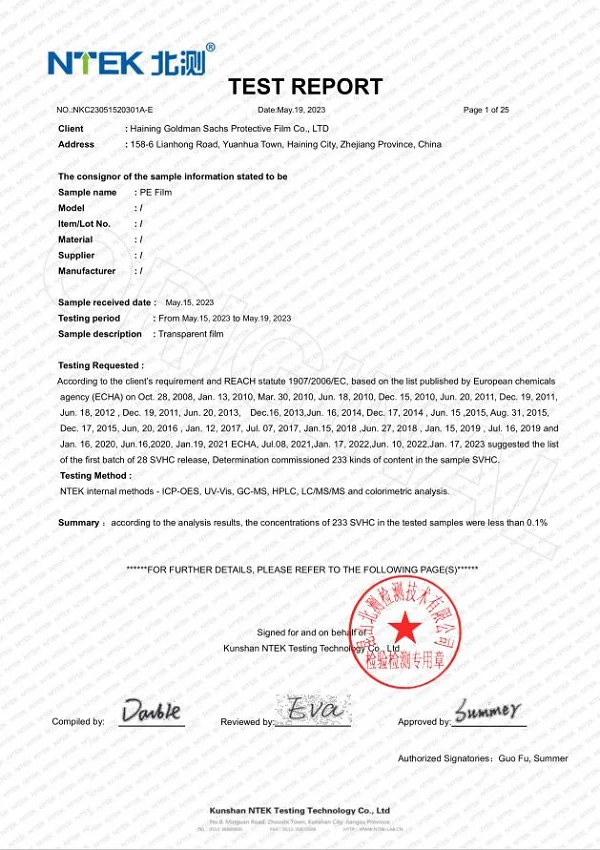
Our company have approved by ISO9001 International Quality System Certification, MSDS Report, ROHS Report and REACH Report, strictly carried it out in the process of research, production and selling.

 

productcate-1-1
productcate-1-1
productcate-1-1
productcate-1-1


Our Factory

The company has advanced printing equipment and coating equipment, adopts strict quality inspection system, and has passed ISO9001 management system certification for many years. The company always adheres to the tenet of building the foundation of quality, establishing the monument of quality, and raising the sail of the brand.

productcate-1-1
productcate-701-349
productcate-702-344


Contact Us


Name:

Serena

1

>>

Phone:

+86-18867669661

+86-18324364871

2

>>

Email: 1525262631@qq.com

3

>>

What's up/Wechat:

+86-18324364871

4

>>

Address:

No. 158-6, Lianhong Road, Yuanhua Town, Haining City, Jiaxing City, Zhejiang Province

5


Frequently Asked Questions


Q: What is Glass Protection Film?

A: When you’re dealing with smooth and glossy surfaces like glass, bare metal, certain plastics and glassy laminates, protective film is the last line of defense between your products and the hazards of the outside world. This film can keep dirt, paint and other forms of contamination such as scratches and dings from affecting surfaces, preventing costly returns and helping the items get to their destinations, clean and blemish-free.
Glass protection film is a thin, self-adhesive covering that comes in a variety of colors and performance capabilities. Its purpose is always roughly the same — to protect surfaces from any harm that may befall them, typically including dirt, scratches and contaminants like paint.
Protection film is temporary, with a high-tack adhesive on one side. That means once the protected item reaches its destination, the film is peeled away, leaving no traces or sticky residue. Protective film may be in place while an object is transported from a factory to a job site for example, or while that item is left in storage awaiting use.
Manufacturers can even apply protective film during the production process to ensure that vulnerable surfaces don’t pick up dirt, scratches or other imperfections as they move along the assembly line.

Q: What are the common problems with Glass Protection Film and how to solve them?

A: Poor Surface Adhesion. If the film peels off too easily there are multiple things that could have caused it:
The surface was not clean enough or was contaminated by dust or moisture.
If the incorrect film for the project was used, it could easily result in an insufficient amount of adhesive or too low a tack for the climate and conditions.
The film was not stretched uniformly during installation creating a distortion and therefore an ineffectual seal.
 
Debonding.  If the film actually separates from the adhesive it leaves a residue on the surface.  Adhesive removal is remedied with a clean cloth dipped in an appropriate amount of organic solvent such as ethanol or acetate. Care should be taken during this step so as not to create an additional cosmetic problem to the protected surface upon removal.
 
Edge Lift.  This occurs when ends of the protective film begin to lift off the surface. Common in metal protection where composite protective film is used, it happens especially with aluminum as compared to steel. Again, the right film for the job makes the difference.
 
The Film Cannot Be Removed.  The most common reason for this problem is the quality of the pressure-sensitive adhesive. Beware of manufacturers who have not mastered the production of this very specialized adhesive technology. Some have only tweaked ordinary adhesives by making some improvements to existing formulations — with disastrous consequences.
 
Another reason why you’d have difficulty removing the film could be an overexposure to sunlight. This is why the UV rating of the film and the determination of how long you need it to adhere is an essential pre-installation determination.
 
Ghosting. One of the primary objectives of any construction project is to make it a seamless transition, where literally no evidence is left behind. When visual blemishes are apparent on what were supposed to be protected surfaces, the main cause of this “ghosting” is due to residue build up left behind from the markers, cleaners, solvents previously used to clean surfaces. These can be removed with care and diluted solvents.

Q: What issues should you consider before choosing Glass Protection Film?

A: Will the film be applied to a rough or a smooth surface? Rougher surfaces have more surface area and require a thicker adhesive.
Is the surface area clean and dry? Dirty application conditions will likely yield unacceptable results. Embedded materials and unnecessary debris adversely affect a protective film’s performance.
Will the surface be painted or have a coating? Chemical reactions can exist between adhesives and coatings, especially the longer they are in contact with each other.
What type of surface needs to be protected? Be it wood, stone, metal, glass, plastic, or ceramic; these surfaces require completely different adhesives to perform successfully.
Will the film be exposed to elevated temperatures? Most rubber-based adhesives cannot handle temperatures above 150°F. Acrylic adhesives are effective at temperatures up to 350°F, and silicone adhesives up to 500°F.
Will the film be used outdoors? If so, for how long? The sun’s UV rays destroy adhesives over time. Protective film will not only yellow, but will become stiff and brittle, and therefore rendered ineffective. The length of time the film will be exposed to the elements will determine how much UV protection it needs.
What is the scope of the project? Do you need to protect windows with a PVC film or do you need to provide a moisture and vapor barrier on a slab where a LDPE (Low Density Polyethylene) film is the answer? 
Will the film be used in a safety or security application? On any  project, it’s safety first. Is the purpose of the film to protect workers from shattering glass or to deter intruders?
How long will the film need to adhere to the surface? If this is a long-term job, some additional component(s) may need to be added to ensure the bond of the surface to the film for the length of time you need it to hold fast.
Will storage and transportation affect the film? Your crew may withstand extreme climates better than your materials! Consider their transport to the job site as well as the material’s subsequent storage so it doesn’t compromise effectiveness. Keep films and tapes in a cool, dry place.
Once affixed to a clean, dry surface, protective film effectively prevent “damage” to that surface. Although incredibly versatile, use the wrong protective film for the job and you’ll jeopardize both your timeline and the always dreaded budget overages.

Q: What other applications does Glass Protection Film have?

A: Protective Film for Vehicles
Protect interior and exterior parts on automobiles, marine and other vehicles from scratching, abrasion and contamination with the right protective film. Protect critical surfaces from time of manufacture thru transit, to the showroom floor.
 
Protective Film for Metals
We excel at servicing the metals industry with a portfolio of protective films designed to adhere to the specific metal surface it is in contact with. Whether it's a mirror—stainless steel finish or a textured painted building panel, both are a delicately finished surface that needs to remain damage free.
 
Protective Film for Plastics
Plastic parts are susceptible to scratching, marring, or damage in every stage of its journey. Fortunately, the proven performance of our protective film products will help assure the performance and appearance of yours.
 
Protective Film for Solid Surfaces
A single scratch, blemish or stain on a solid surface or laminate material can immediately impact your bottom line, not to mention your reputation. Our protective film solutions can preserve your decorative surfaces and guard your reputation.
 
Protective Film for Building & Construction
Protect everything from carpeting, countertops, appliances, even windows and doors from activity and worker traffic. Our adhesive coated films adhere to and protect just about any surface to prevent damage.
 
Protective Films for Appliances
Temporary Protective Films for appliances are uniquely designed to provide temporary surface protection on a wide range of metal finishes and coatings.

Q: What Is Polyethylene Tape?

A: Polyethylene tape is a type of plastic tape made from a polyethylene film backed with a rubber adhesive. Polyethylene film is made from a thermoplastic polymer made from the polymerization of ethylene gas. A rubber adhesive is added to the polyethylene film to make a strong tape that is durable and versatile.
There are several types of polyethylene film, each with a different density and use. Polyethylene tape is categorized by the tape’s density:
Low-Density Polyethylene Film (LDPE)
Linear Low-Density Polyethylene Film (LLDPE)
Medium-Density Polyethylene Film (MDPE)
High-Density Polyethylene Film (HDPE)

Q: Where Can You Use Polyethylene Adhesive Film?

A: Polyethylene Adhesive Film can be used as construction tape, masking tape, patching tape, repair tape, or stucco tape. Stucco tape is a heavy-duty construction tape that can adhere to numerous types of surfaces, like stucco. It’s not limited to stucco, however. You can use it for concrete, brick, metal, vinyl, and wood.
Polyethylene Adhesive Film is not only adhesive to a variety of surfaces, but it is also chemical resistant, moisture resistant, abrasion resistant, and can be UV resistant, making it an excellent protective tape. It will not crack or crease in low temperatures and does not yellow with age.
Protective plastic sheets and films can also be made of polyethylene. The surface protection tape that you find on new appliances is made of polyethylene film.
The various colors available make polyethylene film tapes useful for color coding. 

Q: What are the characteristics of Glass Protection Film?

A: Polyethylene Film is a popular and highly versatile product that is used in a wide range of applications. In the form of continuous film and sheets, polyethylene is also known as PE, plastic, or poly film.
Beneficial attributes of this film include:
Conformability
Water Proof
Long term stability
Comes in various thicknesses
Performs well at wide temperature ranges
Will not crack or crease at low temperatures
Abrasion, solvent, and moisture resistant
Can be customized to fit the application.
 
Polyethylene is virtually waterproof, but will allow elements like oxygen and carbon dioxide to pass through. Its appearance is typically clear, but it can be opaque, depending on application needs. Different materials can be added to polyethylene film to customize its attributes for specific applications. Characteristics that can be added include:
Adhesive
Flame resistance
UV resistance
Anti-static properties
Higher tensile strength
High or low slip coefficient
Polyethylene film is widely used in construction as a vapor barrier, window film, flooring and countertop protective film, and more. It is ideal for protecting building materials, sealing off rooms, and protecting floors in place of dropcloth.

Q: What are the characteristics of Glass Protection Film?

A: High-quality glass protection films typically possess the following characteristics:
High transparency: High-quality glass protection films have excellent transparency, ensuring minimal impact on the glass’s visual appearance and light transmission. The protective film should virtually be imperceptible, without causing any blurring or discoloration effects.
Exceptional scratch resistance: Premium glass protection films exhibit excellent scratch resistance, effectively preventing surface scratches and abrasions on the glass. This helps maintain the original appearance and smoothness of the glass.
Stain resistance: High-quality protective films often feature stain resistance, effectively repelling fingerprints, grease, dust, and other contaminants. This makes it easier to clean the glass surface, reducing the frequency and effort required for cleaning.
UV resistance: Excellent glass protection films possess UV resistance, effectively blocking the harmful effects of UV rays. This helps protect interior items from fading and damage caused by UV radiation, while also contributing to temperature regulation and energy efficiency indoors.
Long-term durability: High-quality protection films should exhibit exceptional durability, withstanding daily use and environmental factors. They should be able to maintain their performance and appearance over an extended period without wrinkling, bubbling, or peeling issues.
Easy installation and removal: Premium glass protection films should be easy to install and remove, minimizing the occurrence of air bubbles or residue during the installation process. Additionally, when replacement or upgrading is required, the protective film should be easily removable without leaving adhesive residue or debris.
Eco-friendly and non-toxic: High-quality protection films should be environmentally friendly and non-toxic, free from harmful substances that could negatively impact human health and the environment.
These characteristics help ensure that glass protection films provide excellent protective effects while maintaining the aesthetic appeal and quality of the glass. When selecting a glass protection film, customers should consider these characteristics and choose a high-quality product that meets their specific needs.

Q: How to choose Glass Protection Film?

A: Surface protection plays a vital role in safeguarding critical surfaces from scratches, UV rays, marring, and dirt contamination. When it comes to selecting the appropriate surface protection film or fabric tape, it’s essential to consider various factors to ensure optimal performance and protection. 
 
Understand the Surface to Be Protected:
Different surfaces require specific types of protection, and understanding the surface you need to protect is crucial. Take into account the material and texture of the surface. For example, surfaces can be made of glass, plastic, stone, granite, or have painted finishes. Each surface may have different properties and require specific protection. A smooth glass surface may need a different protective film compared to a rough stone or a painted surface.
By identifying the surface material and texture, you can select the appropriate protective film that is designed to adhere effectively and provide the necessary protection. This ensures a strong bond and reliable surface protection.
 
Determine the Purpose of Protection:
Defining the specific reasons for surface protection is essential in choosing the right solution. Consider the potential threats and risks the surface may face. For instance, if you need protection against dirt or dust contamination, you may require a different solution compared to protection against scratches or harmful UV rays. Additionally, factors like extreme temperatures, pressures, or humidity levels may require specialized protection.
Understanding the purpose of protection helps you narrow down your options and select the most suitable protective film or tape for your specific needs. This ensures that your chosen solution addresses the specific challenges your surface may encounter.
 
Evaluate the Desired Properties of the Protection Film:
When choosing a surface protection film or tape, it’s crucial to evaluate its properties to ensure it meets your requirements. Consider factors such as pressure and temperature tolerance. Depending on your application, you may need a film that can withstand high pressures or extreme temperatures without compromising its protective qualities.
The quality of the adhesive used in the film is another important consideration. While strong adhesive properties are desirable for long-term projects, temporary applications may require less aggressive adhesives to ensure easy removal without causing damage to the surface.
By assessing the desired properties of the protective film, you can ensure that it possesses the necessary characteristics to effectively protect your surface and withstand the demands of your application.
 
Consider Indoor or Outdoor Applications:
Determining whether the surface protection will be used indoors or outdoors is crucial in selecting the right solution. Outdoor applications expose the protective film to various environmental elements, such as sunlight, rain, and temperature fluctuations. In such cases, the protective film should have excellent anti-UV protection and be waterproof to prevent degradation and damage. UV rays can cause yellowing and brittleness in films that are not designed for outdoor use.
Indoor applications may not require the same level of UV protection or waterproof properties. However, it’s still important to consider other environmental factors, such as humidity or chemical exposure, that may affect the performance of the protective film.
By considering the indoor or outdoor environment, you can choose a surface protection film that is specifically designed to withstand the conditions it will be exposed to, ensuring long-lasting and effective protection.
 
Determine the Duration of Protection Needed:
The length of time the surface requires protection influences the choice of adhesive strength and durability. For long-term projects, you need a protective film with stronger bonding properties that can adhere securely to the surface over an extended period. On the other hand, if the protection is only needed temporarily or for a short duration, selecting a film with less aggressive adhesives makes removal easier without leaving residue or causing damage.

Q: What are the design features of Glass Protection Film?

A: Durable hardcoat surface protection layer protects from scratches and scuffs.
Non-tacky adhesive is bonded to the base but removes easily from the surface with no residue.
Protective hardcoat layer provides resistance to household chemicals and cleaners.
Anti-fingerprint/oleophobic surface makes fingerprints less visible and easy to clean.
Thin film construction is ideal for screens/displays with multi touch operations.

Q: What are the tips for choosing surface protective film?

A: Consider The Type Of Surface:
Not all your products or equipment is born out of the same material. Metal, plastic, glass, granite / stone, carpeting, painted surfaces – given that the texture of each one of these materials is different, they call for different kinds of protection films. You have to analyse whether the texture is smooth, embossed, matte, coated, and such. It is important to first determine the properties of the material to be protected before choosing the films. They have to be compatible with the textures of the surfaces to best protect them.
 
Elements That The Surface Needs Protection From:
The next important factor to consider is what exactly does your product surface need protection from. Be it dirt or humidity in the air – every element affects the surfaces differently. The films required to protect surfaces from dust are different from those that work against high temperatures, pollution, UV rays, scratches, and such. If there are multiple surface damaging elements involved, have no worries; there are plenty of multi-use films available in the market. 
 
Indoor / Outdoor Application:
Knowing whether the surface is going to be situated indoors or outdoors is key to selecting the right surface protection film. Surfaces placed outdoors will naturally be more exposed to harsh sunlight surfaces, and so, would require films with UV protection properties. As the seasons shift, the films should also have the potential to prevent damage from rainfall, meaning that they have to be waterproof. If not chosen wisely, the protection film may peel off in a matter of days, post application.
 
The Desired Period Of Protection:
The ideal surface protection film largely depends on the duration period of the requirement. Films with strong adhesion properties will work best for long-term protection. On the other hand, they might not prove to be the right solution if the protection has to be for a shorter period of time. Peeling them off the surface will be a trick because of the excessive stickiness.  
 
Treatment Required For Certain Surfaces:
Not all surfaces are easy to manage, some require pre-application treatment so that the films fit well right. At times, it is the only way to ensure absolute protection. Before choosing the film, decide on whether the surface needs any further treatment. If yes, what kind of treatment will be best for that particular surface. Furthermore, in case of complex surfaces, you may also need to call in the experts to effectively apply the film to the surface.
 
The Effects Of Transportation:
When migrating equipment from one place to another, more often than not, we see cases of collateral damage – nothing too significant, but costs you something nevertheless, especially when transporting to remote places. You can ensure extra protection for surfaces during transports by leveraging the power of thicker protection films. You must also consider the effects of transportation on the films. If they are being brought to you from a distant location, custom shipping tapes are your best bet.

We're well-known as one of the leading glass protection film manufacturers and suppliers in China. Please feel free to wholesale high quality glass protection film made in China here from our factory. For custom service, contact us now.

Clear glass film, Car part Protective film, Aluminum Protector film