Stainless Steel Protection Film

Wholesale Stainless Steel Protection Film Manufacturer


Haining Gaosheng Protective Film Co., Ltd., is a professional enterprise integrating R&D, production and sales of various surface protective films. Our products include Carpet Protection Film, Floor Protection Film, Tile Protection Film, Marble Protection Film, Glass Protection Film, Barrier Film, Stainless Steel Protection Film, Aluminum Protection Film, Anti-Static Film, Metal Protection Film, Household Appliance Protection Film, Car Protective Film, Packaging Stretch Film, Packaging Tape.


Why Choose Us?

Rich Experience

Haining Gaosheng Protective Film Co., Ltd. was established in 2002. After 20 years of intensive cultivation, it has become an enterprise with a certain reputation and customer trust in the industry.


Wide Range of Applications

Our products are widely used in industries such as aluminum-plastic panels, stainless steel panels, color steel panels, galvanized panels, glass, stone, electronics manufacturing, home appliances, automobile manufacturing, and high-end furniture.

Advanced Equipment

We have a full set of advanced film blowing equipment, printing equipment and a number of coating lines and cutting lines.

Professional Technical Team

We have an excellent and professional team with over 30 people working on researching, producing and sale.


First 123 Last

Brief Introduction to Stainless Steel Protection Film


The stainless steel protective films are intended to protect the surface of the stainless steel from scratches and scuffing during storage, handling and working prior to and during installation. They should be removed once in service. The film is effective because it attaches to the stainless steel exterior and remains in place until the consumer removes it. When they do, they’re left with a sleek, smooth surface to complement their home.


What are Advantages of Stainless Steel Protection Film?
 

PE Protective Film is More Environmentally Friendly
Stainless steel protective films are made from PE (polyethylene), which is not only cheaper than traditional materials but also more environmentally friendly than PVC. They reduce the amount of oil and lubricants needed in the production process, thereby reducing costs and increasing profitability, all while helping to protect the environment.


Stainless Steel Protective Film Increases Productivity
Simultaneously, stainless steel protective films help to boost productivity. Printed arrows and stripes on the film allow for quick identification of the polishing direction. The 'easy peel' nature of the protective film allows for faster removal, thus speeding up the process and increasing productivity.


Protective Films Protect Against Scratches and Damage
Regardless of whether the stainless steel has been polished, sanded, blasted, or honed, or whether it has a rough, 3D, or high-gloss bright annealed (BA) finish, the adhesive strength of the stainless steel protective film always matches the surface structure. This provides reliable protection for the finished surface against scratches and damage during subsequent processing. These specially deep-drawn films for stainless steel sheets can even withstand severe deformation.


Types of Stainless Steel Protection Film


White Polyethylene (PE) Protective Film
The appropriate protective film for most applications is polyethylene (PE), with a rubber adhesive layer. This film is applied by default as to the protected surface when the quality of the film to be used is not specified.
The sheet plastic material is nominally 80 micrometres thick. It is white and may have two blue stripes printed at intervals across the width. The stripes have no significance.
The adhesive may be clear or black. Clear adhesive looks white on the film.
To prevent adhesive transfer, film with clear adhesive should not be exposed to the sun for more than a few hours to avoid breakdown of the adhesive, which will leave a residue on the surface of the stainless when the film is stripped off. Film with a black adhesive should be stable in the sun for a few months as they absorb heat.
The protected surface may be plasma or laser cut with the film in place, as it does not produce toxic or corrosive products when burnt. When laser cutting, for best results cut from the side which does not have the plastic applied, or use oxygen to assist and cut from the protected side.


Light Blue Polyvinyl Chloride (PVC) Protective Film
This film is appropriate for deep drawing application, particularly multi-stage deep drawing. It is a polyvinyl chloride (PVC) film, with a rubber adhesive layer.
The film is nominally 70 micrometres thick, and is light blue in colour.
The film should be used at a temperature between 15°C and 40°C.
The film should not be exposed to the sun for more than a few hours to avoid breakdown of the adhesive, which can cause adhesive transfer, which may interfere with deep drawing or leave a residue on the surface of the stainless when the film is stripped off.
The steel should not be plasma or laser cut with the film in place, as the film will produce fumes containing hydrochloric acid which are toxic and corrosive.
The film should be removed from the steel after pressing, at a temperature between 15°C and 40°C.


Black Polyvinyl Chloride (PVC) Protective Film
This stainless steel protection film is appropriate for heavy roll forming and other applications requiring heavy surface protection. It is a polyvinyl chloride (PVC) film, with an acrylic adhesive layer, and a very high level of adhesion.
The film is nominally 120 micrometres thick, and black in colour.
The film should be used at a temperature between 15°C and 40°C.
The film is weather resistant, and can be exposed to the sun for several months while offering reliable protection.
The steel should not be plasma or laser cut with the film in place, as the film will produce fumes containing hydrochloric acid which are toxic and corrosive.


Protective Films for Laser Cutting
Special films are required for both CO2 and fibre optic laser cutting technologies. Appropriate laser absorption and resistance to cutting gas pressures have always been the main prerequisites needed for these films.


Other Protective Films
Other suppliers may use white PVC films for general surface protection. This is less likely than hitherto as PVC films are significantly more expensive than PE films.


Process of Stainless Steel Protection Film

Extruder
The first step involves feeding the resin pellets into an extruder, which melts and homogenizes the resin using heat and pressure. The molten resin is then forced through a screw and into the die assembly.


Melt Filtration
Before entering the die assembly, the molten resin undergoes a melt filtration process to remove any impurities and contaminants. This ensures that the final product is free from defects and has consistent quality.

Die Assembly

The die assembly is the heart of the blown film process. It is where the molten resin is shaped into a film. The die consists of an annular opening that shapes the molten plastic into a hollow tube. The diameter of the die opening determines the width of the film, while the thickness is controlled by adjusting the extrusion rate.

Bubble Cooling

As the tube of plastic emerges from the die, it is immediately inflated into a bubble using air pressure. The bubble is then cooled using chilled air or water, which solidifies the plastic and sets its final dimensions.

Winding

Once the film is cooled, it is collapsed into a flat sheet and wound onto a roll. The winding speed and tension are controlled to ensure that the film is wound neatly and without wrinkles.


How do I Remove the Protective Film from Stainless Steel?


Gather Your Supplies

Soft Cloth or Sponge: Choose a non-abrasive cloth or sponge to avoid scratching the stainless steel.
Mild Dish Soap: Create a gentle soapy solution using mild dish soap and warm water.
Rubbing Alcohol or White Vinegar: These can help in removing any adhesive residue left behind by the protective film.
Microfiber Towel: Ideal for polishing the stainless steel once the film is removed.

Peeling off the Film

Start by locating an edge or corner of the protective film. Gently peel it back, taking care not to scratch the stainless steel. If the film is stubborn, use a plastic scraper or your fingernail to lift the edge without damaging the metal.

Soapy Solution Application

Mix a small amount of mild dish soap with warm water to create a soapy solution. Dip the soft cloth or sponge into the solution and gently wipe the exposed stainless steel. This helps in loosening the adhesive and any residue from the film.

Wipe Away Residue

If any adhesive residue remains, dampen a corner of the cloth or sponge with rubbing alcohol or white vinegar. Gently rub the residue until it lifts away. Be cautious not to use excessive force, especially on brushed or textured stainless steel finishes.

Rinse and Dry

Rinse the stainless steel thoroughly with clean water to remove any soap or cleaning solution. Use a dry microfiber towel to wipe the surface completely dry. This step prevents water spots and ensures a streak-free finish.

Polishing for Shine

For an extra touch, you can use a stainless steel cleaner or a mixture of white vinegar and water (equal parts) to polish the stainless steel. Apply the solution with a soft cloth and buff the surface gently in the direction of the grain for a sparkling finish.

Check for Residue

Inspect the stainless steel for any remaining adhesive or film residue. If needed, repeat the process until the surface is entirely clean and free of any protective film remnants.


The Considerations for Buying

The Degree of Light Penetration
Light penetration is the most important thing when choosing PE protection films for stainless sheets. On the other hand, it becomes difficult to view the same through the naked eye and requires optical instruments. It can be known by performing some simple techniques.


Static Electricity
Static electricity is another factor to consider when selecting PE protection films. It is necessary to make sure that a PE protection film has less static electricity.

Haze

Haze is the next thing to keep in mind when selecting PE protection films for stainless steel sheets.

Scratch

Although PE protection films are scratch-resistant, it is wise to check the scratch-proof before selecting them.

Anti-Finger Point

Anti-finger point is another factor to keep in mind before choosing PE protective films. A PE protective film should have an anti-finger point to minimize unwanted problems.


Our Certificate

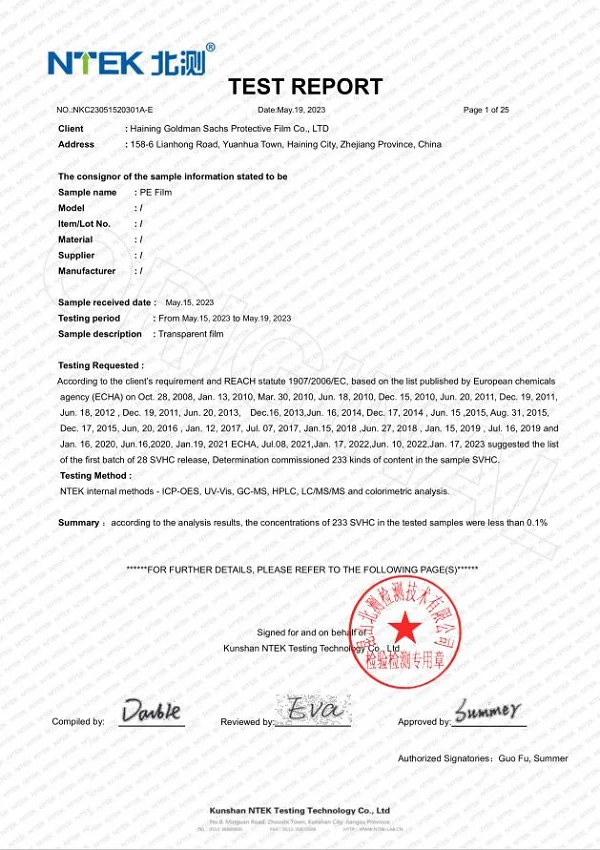
Our company have approved by ISO9001 International Quality System Certification, MSDS Report, ROHS Report and REACH Report, strictly carried it out in the process of research, production and selling.

 

productcate-1-1
productcate-1-1
productcate-1-1
productcate-1-1


Our Factory

The company has advanced printing equipment and coating equipment, adopts strict quality inspection system, and has passed ISO9001 management system certification for many years. The company always adheres to the tenet of building the foundation of quality, establishing the monument of quality, and raising the sail of the brand.

productcate-1-1
productcate-701-349
productcate-702-344


Contact Us


Name:

Serena

1

>>

Phone:

+86-18867669661

+86-18324364871

2

>>

Email: 1525262631@qq.com

3

>>

What's up/Wechat:

+86-18324364871

4

>>

Address:

No. 158-6, Lianhong Road, Yuanhua Town, Haining City, Jiaxing City, Zhejiang Province

5


Frequently Asked Questions


Q: How to peel off Stainless Steel Protection Film and clean stainless steel?

A: On occasions, the stainless steel protection film is left in place for too long. It may become very hard to strip, and may also leave a gummy or friable residue of degraded adhesive on the steel surface require extensive cleaning time on the protected surface side.
The residue is unsightly, makes achieving smooth surfaces difficult, and may also impair corrosion resistance by retaining atmospheric corrodents which settle on the steel surface.
Even if the stainless steel protection film is stripped promptly, there may be small amounts of this residue left, although they may not be visible. It is prudent to clean the surface after stripping the film.
The adhesive residue can be cleaned from the surface of the steel with a solvent such as methyl ethyl ketone (MEK), eucalyptus oil or a similar solvent.
The surface should be swabbed with the solvent on a clean, soft, grit free cloth, left to soak in, then the solvent wiped off (and use elbow grease). The intent is to dissolve the adhesive into the solvent, then wipe off the solution. Hence the solvent chosen should not evaporate too rapidly. Consideration should also be given to the flashpoint and toxicity of the solvent.
Care should be taken to avoid marking the stainless – check a small area after the solvent has dried, as fine scratches may not be visible while the surface is wet.
Highly adherent films which have baked onto the steel may require an extended soaking period with the solvent, preferably after pulling away strips of film to allow access of the solvent to the adhesive.
The solvent may leave tide marks, which can usually be removed with an alkaline detergent and hot water, well rinsed. Allow the steel surface to dry naturally, blot dry with a clean rag, or blow dry with clean air.

Q: Why use Stainless Steel Protection Film?

A: With stainless steel, finish is everything. Whether you are looking for a brushed, bright annealed or mirror appearance, a single scratch can ruin the value of your product and cut through the protective surface layer which gives “stainless” its name.
The problem is that your stainless steel faces many potential hazards throughout the fabrication, shipping and installation processes. The surface can be marred at any step along the way, and the cost of fixing or replacing the product can put a big dent in your profit margin.
However low-cost stainless-steel protection film provides a great return on investment, as it eliminates scrapes or scratches to the steel surface itself. Any damage or soiling impacts only the protective film, which is then easily peeled off and disposed of. Your product remains completely clean and untouched.

Q: How to Use Stainless Steel Protection Film?

A: Utilizing stainless steel protection film is simple. You can use an applicator to install the stainless steel protection film if you need to put it on a large surface, or you can use your hand and leverage your own pressure for a smaller area.
Follow these steps for proper installation:
Unroll the film and put about half a foot on the edge of the surface where you want to apply it. Push down on it firmly with your hand or applicator.
Keep applying 6-inch sections to the remainder of what you want to be taped up, continuing to add firm pressure.
Use a razor or sharp knife to cut the film when you have finished the covering.
Grab a permanent marker and write the date of application on the film so you can track when it was applied.
Within 45 days of application, remove or replace the stainless steel, per the directions on the film.

Q: What types of Stainless Steel Protection Film are there?

A: White PE Protective Film For Stainless Steel
The protective film suitable for most applications is PE protective film with a rubber adhesive layer.When the quality of the film to be used is not specified, the protective film is applied by default to the surface to be protected.
The adhesive may be transparent or blue. Transparent adhesives look white in the film.To prevent the transfer of the adhesive,protective films coated with clear adhesive should not be exposed to sunlight for more than a few hours to prevent the adhesive from breaking down and leaving a residue on the stainless steel surface when the film is peeled off. Films with black adhesive should be stabilized in the sun for several months as they absorb heat.
Protected surfaces can be cut with plasma or laser film, as it does not produce toxic or corrosive products when burned. When laser cutting, for best results, cut from the side to which no plastic is applied or use oxygen to assist in cutting from the protected side.
 
Blue PVC Protective Film
Blue PVC protective film is suitable for deep-drawing applications, particularly multi-stage deep-drawing. It is a polyvinyl chloride (PVC) film with a rubber adhesive layer. The film has a nominal thickness of 70 microns and is light blue in color. The protective film should be used at a temperature of 15C to 40℃.
Do not expose the protective film to sunlight for more than a few hours as this may cause the adhesive to break down and lead to adhesive transfer, which may interfere with deep punching or leave a residue on the stainless steel surface when the film is peeled off.
Steel should not be plasma or laser cut with the protective film in place as the protective film will produce fumes containing toxic and corrosive hydrochloric acid. The protective film should be removed from the steel after pressing at a temperature of 15℃ to 40℃.
 
Black PVC Protective Film
This stainless steel protective film is suitable for heavy-duty roll forming and other applications where heavy-duty surface protection is required. It is a polyvinyl chloride (PVC) film with an acrylic adhesive layer that provides a very high adhesive strength. The protective film should be used at temperatures between 15C and 40°C. The protective film is weather resistant and can be exposed to sunlight for several months while providing reliable protection.

Q: What are the unique features of Stainless Steel Protection Film?

A: This Easy-Peel effect means these protective films are an innovative protection solution which make production line processes even more efficient and significantly cut production times. Even large areas and challenging component shapes can be stripped of the protective film in a matter of seconds. The combination of an optimised adhesive system and a highly tear-resistant carrier film also guarantees the unblemished appearance of the surface: these films can be removed reliably and cleanly, without leaving residues. As a result there is subsequently no need for costly finishing work. 
Protective films are perfectly suited to the requirements of different surface textures, gloss grades and special surface coatings. They are also available in a range of different film thicknesses and adhesive strengths.

Q: What finishes is Stainless Steel Protection Film suitable for?

A: Stainless steel is frequently used for surfaces due to its attractive finish.  The challenge is preserving its appearance from manufacturing to shipping to installation.  Whether it’s a brushed, annealed, or mirror finish, preventing scratches is critical to keeping the value of the material. 
To preserve the finish of your stainless steel until it’s time to shine, use stainless steel protection film.  Our temporary protective films can protect the delicate finish of your stainless steel surfaces from the factory to installation. 
The film is suitable for the following exterior finishes:
2B Mill Finish
2BA Bright Annealed
3 & 4 Dry Polish
7 & 8 Mirror Finish
The film is capable of protecting a stainless steel surface from scratches, dust, dirt, and contamination.
Suitable for all stages before installation, including manufacturing, storage, and shipping.
Polyethylene film is coated in a water-based acrylic adhesive that leaves no residue behind – no cleanup is needed after installation.
Available in clear, blue, and black/white.

Q: Why is Our Stainless Steel Protection Film Popular?

A: Our PE Laser Cutting Protective Film is specifically designed to protect stainless steel surfaces from scratches and damage during laser cutting, installation, or transportation. This laser film uses environmentally friendly polyethylene as a carrier and is coated with natural rubber adhesive. It can be applied to mirror surfaces, blasted or sanded surfaces, and other 3D or angled surfaces, providing stable and firm adhesion. Importantly, after peeling off the film, the surface remains perfectly clean and untouched.
Features:
Environmentally friendly polyethylene film as the carrier
Coated with natural rubber adhesive
Protects product surfaces from pollution, damage, and UV exposure
Enhances your brand image by allowing for your logo and contact details to be printed on
Easy to apply and remove, with no adhesive residue after removal
Endures high temperatures and is anti-aging
Offers stable adhesion and special easy-peel features
Protects surfaces from pollution, corrosion, and scratches during production, transport, storage, and installation
Stainless steel is a popular material in various industries, such as architecture, product design, and visual merchandising. However, during processing, its surface can easily be scratched and damaged. Our PE protective film can perfectly solve this problem, helping you reduce repair or replacement costs. Compared with common water-based adhesives, our natural rubber adhesive stainless steel film can resist chemicals, UV exposure, and aging. It can be easily peeled off without leaving residue on the surface. It can be applied not only to stainless steel materials, but also to aluminum sheets, aluminum extruded profiles, and elevator surface protection, among others.

Q: What are the ways to quickly remove stainless steel protective films?

A: Protective films offer considerable protection during use, but many people are interested in how to quickly and effectively remove these films from stainless steel. There are various methods available, and we will introduce a few of them.
One effective method is alcohol removal. Generally, you only need to use a paper towel soaked in some alcohol to wipe off the film. This method is relatively simple and effective, making it a popular choice. It's both practical and common in the market. Many people find it convenient and effective.
In addition, you can use water to wash off the film. This method is similar to the alcohol method in terms of effectiveness. The cost of water washing is very low, and it provides a quick and convenient removal process.
Some people prefer using acetone. This method also works well, especially when used in small amounts. It can thoroughly remove the film, demonstrating its value. Choosing such an effective method allows us to appreciate these benefits and effectively remove the stainless steel protective film quickly.

Q: Is using Stainless Steel Protection Film necessary?

A: Stainless steel is known for its excellent performance and resistance to corrosion. So, why would such a durable material need a protective film? This is primarily because during the processing, production, transportation, storage, and installation of stainless steel products, they may be exposed to pollution, corrosion, and scratches. Without a protective film, these factors can reduce the product's value and even affect its use.
 
From a consumer's perspective, nobody wants to buy a defective product. The use of a stainless steel protective film can effectively prevent damage or scratches on the surface of stainless steel products. When the product is ready for use, simply peel off the protective film to reveal a surface that's as bright as new. For this reason, manufacturers often apply a protective film to stainless steel products.
 
So, what exactly is a stainless steel protective film, and why is it so important? This protective film is primarily made of a special polyethylene (PE) plastic film, with a cross-linked acrylic resin as the adhesive. It is further processed with several special additives. The film is soft, adheres well, is easy to apply and remove, and leaves no residue after peeling. Its greatest advantage is that it preserves the original smooth and shiny surface of the product.
 
To summarize, the advantages of a stainless steel protective film include:
 
High gloss and transparency due to the use of pure new material packaging. It can be applied to the packaging and processing of most products.
Strong tensile strength, thanks to a scientifically optimized formula and high-tech manufacturing processes.
Non-toxic and tasteless, with no mixed materials, making the product safer, healthier, and more environmentally friendly.
Durability, as it's made from high-quality raw materials. The film is wear-resistant, tear-resistant, and chemically stable.
In the current market, users can choose the color of the stainless steel protective film according to their needs. The color options include transparent, white, black and white, and yellow and white, with custom colors available upon request. The film's viscosity varies from medium to high and extra high, or it can be custom-designed based on the roughness of the surface it's meant to protect.

Q: What are the types of PE protection films?

A: PE protection films come in different forms and each of them has slight differences when it comes to adhesion and other properties.
 
Polyvinyl chloride protective film
Polyvinyl Chloride (PVC) is the best choice for metal-forming applications. It comes with a rubber adhesive layer and uses the temperatures between 15°C and 40°C. However, PVC PE film is not allowed for sun exposure for more than a few hours.
 
White polyethylene PE protective film
White polyethylene PE protective film is the most used material for many applications which is white or black in color.
 
Black polyvinyl chloride protective film
Black polyvinyl chloride protective film is weather resistant can be exposed to the sun for several months and provides reliable protection. On the other hand, the film will produce hydrochloric acid fumes which are toxic.

Q: How to Apply Protective Film?

A: Prepare a suitably large, flat work space – larger than the object to be protected − that is clean and free of dust, liquid or contaminants.
Affix a 4.5-foot strip of double-sided tape near each end of the work space… roughly 8.5 feet apart. These will be used to hold the film, not the material that is to be protected.
With the adhesive side facing up, unroll a short section of the protective film. Ensure that it is smooth and wrinkle-free, and attach the loose end evenly to one of the strips of double-sided tape.
Continue unwinding the protective film, laying it out across the length of the work surface to a point just short of the other strip of double-sided tape.
Now, raise the roll of film up and unwind it above and just beyond the double-sided tape. Taking care not to pull the originally attached end free of its tape, adjust the alignment of the film to ensure that it is straight, free of wrinkles and reasonably taut, but not stretched so tightly that the film will tend to shrink back later on. (When films are stretched during application, the edges have a tendency to pull up later on when the film tries to return to its original shape.)
Lower the film onto the second strip of double sided tape.
Using the utility knife, cut the roll away from the now secured sheet of film that is waiting to receive the sheet material that is to be protected.
Square up and position one edge of the piece of sheet material at one end or side of the protective film. Position it just inside where the film is held by the strips of double-sided tape.
Gradually lay the part down onto the adhesive film. NOTE: If the sheet of material is flexible, put a little flex into it as you lay it down on the film, thereby rolling it down and allowing air to escape from between the material and the film.
Voila! You are just about done.
To ensure that the sheet of material is attached to the film, apply pressure to the material, particularly along all edges, to assure a good bonding. A clean paint roller might be used for this purpose.
With the utility knife, trace the outline of the part on the protective film, cutting away the excess film. Remove the excess and dispose of it.
Carefully turn the part over and, if required, apply pressure directly to the film, working outward from the middle, to ensure that the entire area is well adhered.
Inspect the finished piece for a complete, wrinkle-free coverage.

We're well-known as one of the leading stainless steel protection film manufacturers and suppliers in China. Please feel free to wholesale high quality stainless steel protection film made in China here from our factory. For custom service, contact us now.

Laser Stainless Steel Protection film, Stainless Steel Protection Film, Laser Stainless Steel Protective Film